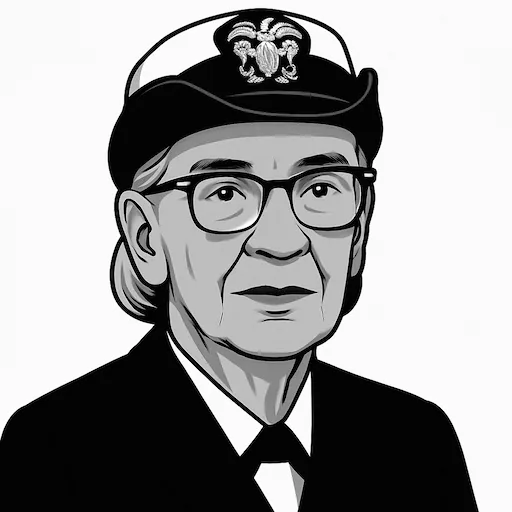


Grace Hopper: The Girl Who Asked Why
Once there was a girl named Grace who always wanted to know how things worked.
She asked why clocks ticked, how radios sang, and what made light bulbs glow. Sometimes, grown-ups told her, "Girls don't need to worry about things like that." But Grace didn't listen. She carried around a screwdriver and a notebook, always ready to open something up and write down what she learned.
One day, Grace took apart all the clocks in her house just to understand them. Her mother wasn't too pleased—but she also wasn't surprised. Grace had always been a little different.
When Grace grew up, she wanted to help her country during World War II. But the Navy said she was too small and too old. Grace said, "I can still think, can't I?" She didn't give up—and soon, she was working with one of the world's first computers, a giant machine called the Mark I.
The Mark I was bigger than a car and could solve math problems faster than any person. But it didn't speak English—it spoke in code. Most people thought the machine was too complicated. Not Grace. She rolled up her sleeves and got to work.
Grace wrote instructions the computer could understand. She made programs that helped it solve problems for the Navy. Once, the computer even stopped working because a moth flew inside and got stuck! Grace taped the moth in her notebook and wrote: "First real computer bug."
But Grace didn't stop there. She had a big idea: What if computers could understand words, not just numbers?
Everyone said, "That's impossible!"
Grace said, "Let's try."
So she created one of the first computer languages, called COBOL. Now, people could write simple instructions using real words—and computers would understand.
Because of Grace, computers became easier to use. Her ideas helped banks, schools, and even space programs solve big problems.
Grace Hopper didn't always fit in. She was curious. She was stubborn. She was different.
And that's exactly what the world needed.